Research
Ongoing Projects in Lab
How Y-box binding proteins regulate cellular and viral RNAs.
(See PMID 42627844, 35189699)
Work by lab alumnus Dr. Tania Strilets – currently looking for individuals interested in this project.
Regulation of alternative splicing of transcripts encoding important immune effectors by DDX39B and DDX39A.
(PMID 38801080, 38575347, 37261960, 35613883, 33568552, 28340352)
Recent work by lab alumni Drs. Shefali Banerjee and Chloe Nagasawa and currently Dr. Sara Mohamed (postdoctoral fellow). Looking for individuals interested in this project.
Translation of viral RNAs: specialized mechanisms of translation initiation and elongation.
(PMID 40089163, 32890404, 29321322, 27974556).
Work of Dr. Leandro Fernandez-Garcia (postdoctoral fellow) and Anna Olson (Laboratory manager) on flaviviruses, and Evan Lam (MSTP student) and Mariam Mithqal (undergraduate student) on how Ebolavirus induced inclusion bodies sequester translation factors and alters host function.
Note: The studies on flavivirus translation initiation are carried out by Dr. Leandro Fernandez Garcia, who will take these with him when he establishes his independent laboratory. The studies on flavivirus translation elongation are a collaboration with Dr. Shelton Bradrick (Trudeau Institute, https://www.trudeauinstitute.org/).
The impact of virus infection on post-transcriptional regulation of host gene expression.
(PMID 36572191, 34359890, 31829086)
Work of lab alumnus Dr. Sapna Sehrawat and currently Alex Maciejczuk (graduate student, co-mentored with Dr. Sarah Dremel).
Note: The work on how Ebolavirus regulates alternative splicing of human immune cells is carried out as part of large collaboration funded by a program project from NIAID. The work on how Herpes Simplex 1 virus regulates alternative splicing of human cells is a collaboration with Dr. Sarah Dremel (UVA).
The use of alternative splicing regulation to enhance cell-type specific expression of transgenes.
(PMID 26751776, United States Patent 9,284,575)
Work of Dr. Sara Mohamed (postdoctoral fellow).
Note. This project is a collaboration with Spark Therapeutics (now Roche).
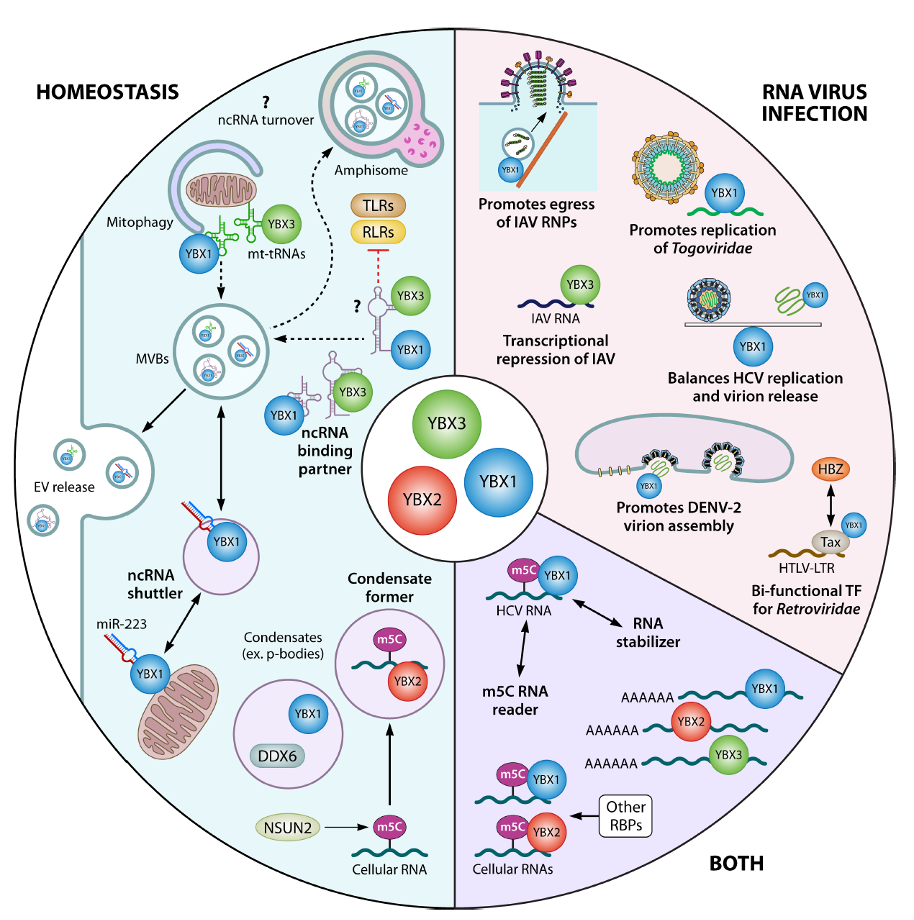
Discrete and overlapping functions of YBXs during cellular homeostasis and RNA virus infection. During cellular homeostasis, YBX1 and YBX3 bind various non-coding RNAs (including miRNAs, Y RNAs, and tRNAs), some of which are known to be associated with autoimmune diseases. YBX1 and YBX3 also bind cytoplasmic mt-tRNAs that are released via mitophagy. YBX1 aids in the shuttling of mitochondrial resident miR-223 into extracellular vesicles, potentially utilizing cellular phase-separated condensates like P-bodies as nucleating points before multivesicular body (MVB) formation and secretion. We hypothesize that YBXs shield immunogenic moieties on cellular non-coding RNAs, including dsRNA regions and 5’-triphosphates, preventing their recognition by cytoplasmic RLRs and TLRs, to prevent the aberrant induction of inflammation (depicted by dashed lines). Alternatively, YBXs may participate in the turnover of cellular non-coding RNAs via their secretion in extracellular vesicles or degradation by MVBs fusing with lysosomes (depicted by dashed lines). YBX1 and YBX2 also form phase-separated condensates, and YBX1 phase-separated condensates co-localize with p-body markers such as DDX6. The global deposition of m5C on RNA by the m5C writer NSUN2 positively affects YBX2’s ability to form phase-separated condensates. YBX1 and YBX2 are both m5C readers and promote the association of other cellular RBPs with m5C-modified RNAs, increasing their stability. Globally, all three human YBXs promote the stability of cellular mRNAs, from post-meiotic germ cells to somatic cells. During infection, YBX1 also stabilizes viral RNA via recognition of an m5C modification on the HCV genome. During infection with Retroviridae, YBX1 both promotes and represses the transcription of HTLV-1, through dynamic association with viral proteins. During infection with Flaviviridae, YBX1 balances HCV replication and virion release, and promotes DENV-2 virion assembly. Across multiple Togaviridae, YBX1 is necessary for efficient viral RNA replication. Lastly, during Orthomyxoviriade infection, YBX1 and YBX3 have opposing anti- and pro-viral functions: YBX3 represses transcription of IAV while YBX1 promotes IAV RNP egress via endosomes. (PMID 40985650)
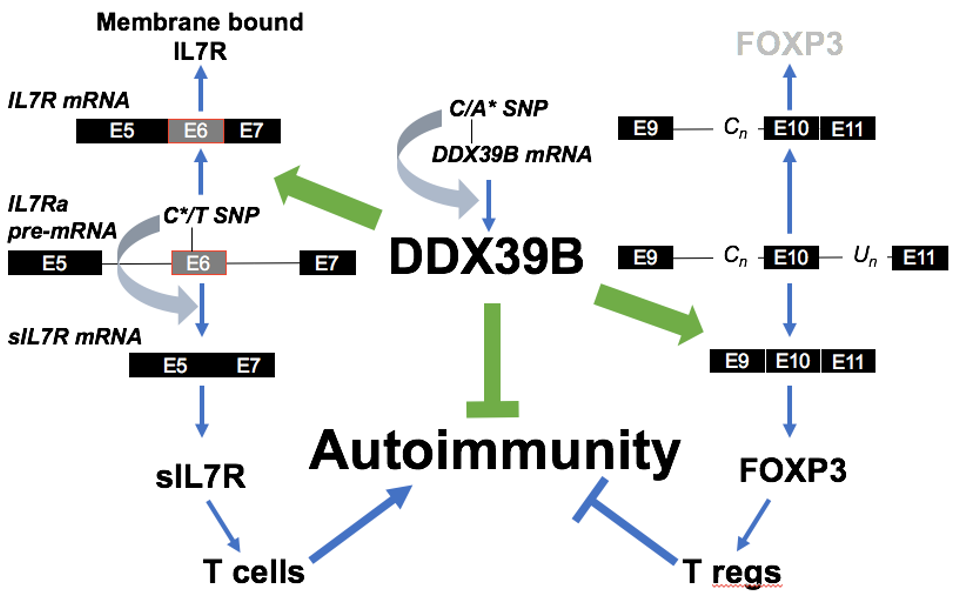
DDX39B as a guardian of immune tolerance. DDX39B activates inclusion of the IL7Ra exon 6, which leads to the formation of membrane bound IL7 receptor and reduces the formation of the soluble IL7 receptor (sIL7R). sIL7R promotes autoimmune diseases such as multiple sclerosis and rheumatoid arthritis by incompletely understood mechanisms and reduction of sIL7R levels reduce these autoimmune reactions. DDX39B also activates the splicing of introns in FOXP3 transcripts leading to efficient expression of FOXP3 protein, which is essential for the function of T regulatory cells (T regs). T regs downregulate autoimmunity. (PMID 28340352 and 37261960)
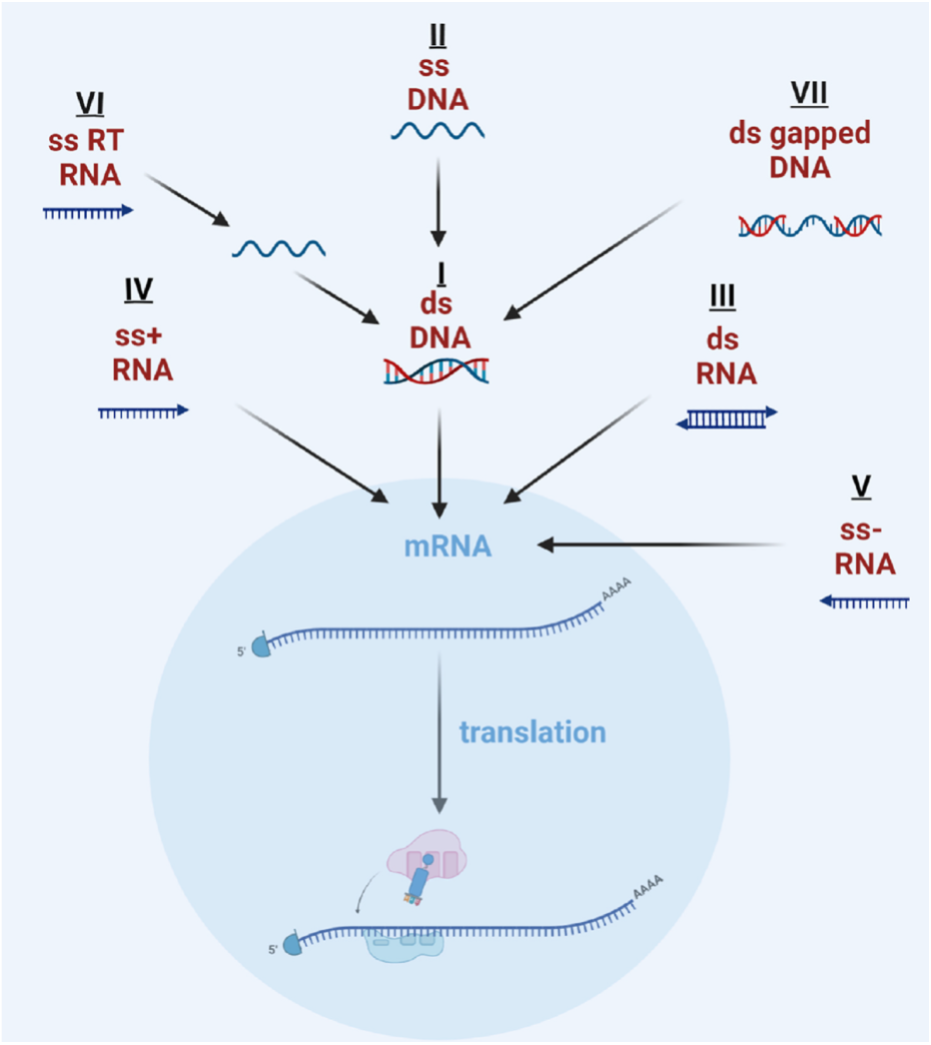
All viral genomes converge in the generation of a mRNA. Viral genomes are classified into seven classes (I-VII) based on their replication strategies and their mechanisms of mRNA synthesis. *mRNA is represented here containing a 5′-cap and a 3′-poly-adenylated tail, which is true for most cellular mRNAs, but not all viral mRNAs. Created in BioRender. Fernandez, L. (2024) https://BioRender.com/h31e575. From ref PMID 40089163.
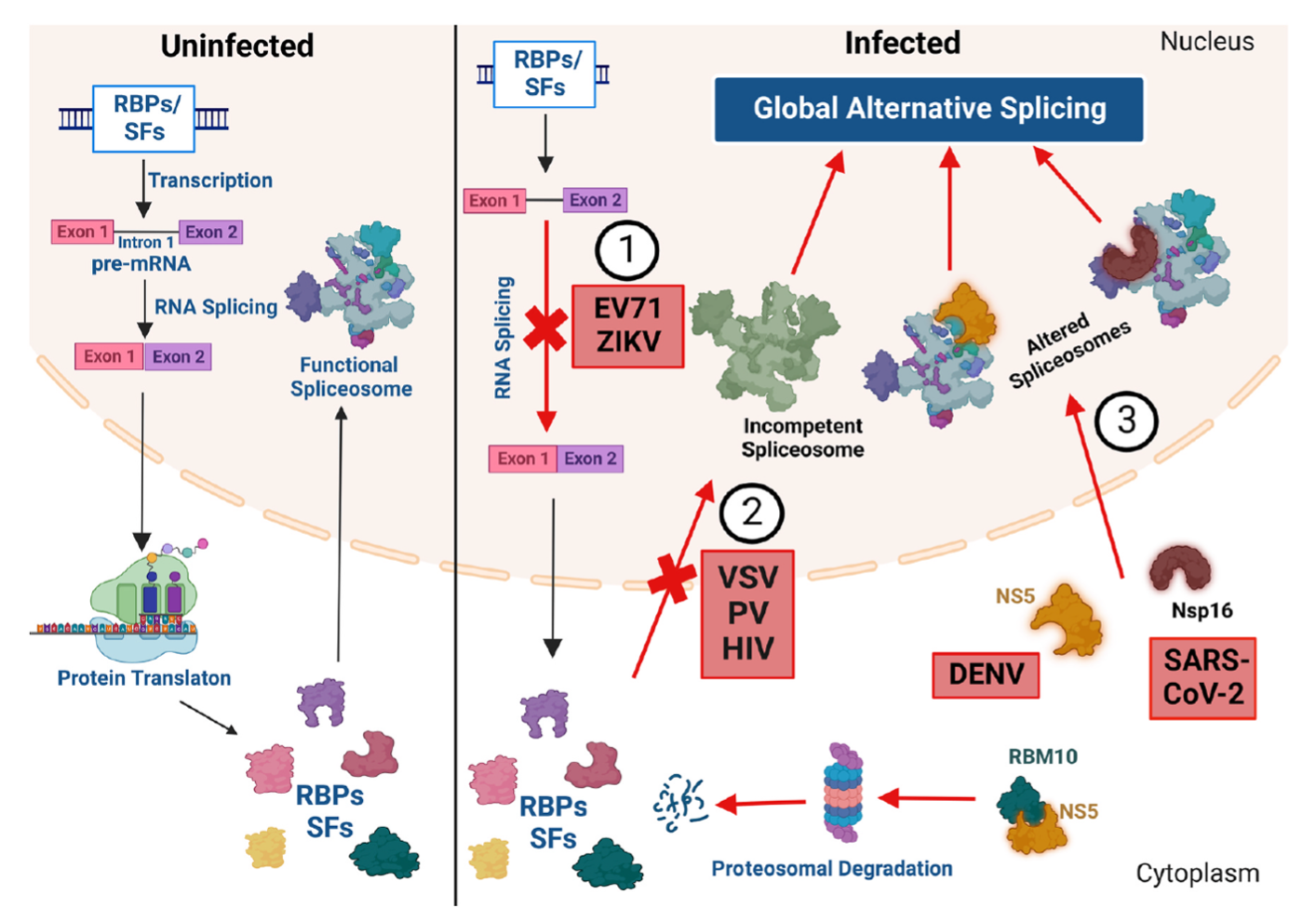
Viruses target different aspects of the splicing pathway to alter splicing patterns in the host cell. The left side of the illustration depicts the transcription, splicing, and translation of the proteins that play a role in RNA splicing in an uninfected cell. The right side presents examples of how virus infection affects alternative splicing.1) Zika virus (ZIKV), and Enterovirus 71 (EV71) dysregulate the splicing of pre-mRNAs of genes coding for RNA binding proteins (RBPs) and splicing factors (SF). 2) Vesicular stomatitis (VSV), poliovirus (PV), and human immunodeficiency virus (HIV) block the nuclear translocation of SFs and RBPs. 3) Dengue virus (DENV) hijacks the active spliceosome via NS5 to deregulate splicing while Nsp16 of SARS CoV2 binds SRSF1 and SRSF2. The red lines represent dysregulated pathways leading to differential alternative splicing events. From PMID 36572191.
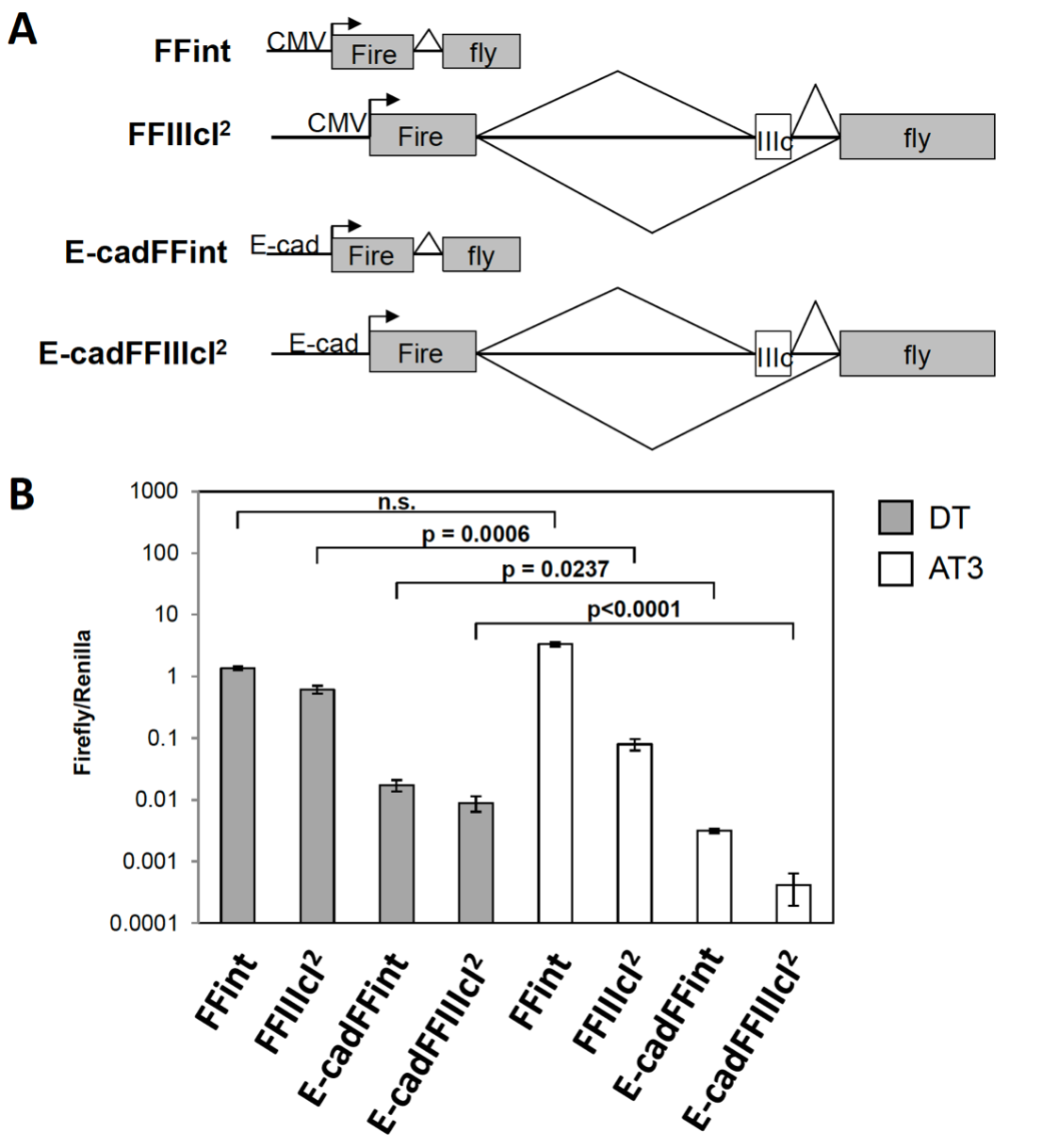
Combinatorial effect of transcription and post-transcriptional regulation on cell-type specific gene expression. Use of the epithelial specific E-Cadherin promoter and mesenchymal specific inclusion of FGFR2 exon IIIc to increase the ratioof gene expression in epithelial cells (DT) vs mesenchymal cells (AT3). Ref PMID 26751776